
Most creative work ends up on a screen or a page. Every so often a project asks you to design something people physically walk into, and that changes the problem entirely.
Stormy Wellington is a speaker, author, and network marketing leader recognized internationally. We were introduced during our time at Total Life Changes; the expo project itself was an independent engagement, working with Stormy and her contact Martha directly.
They came to us because they knew the work and wanted to work with us specifically. That's a good way to start a project.
We designed all the artwork for her reserved space at a Miami expo — walls inside and out, the entire environment. Vibrant and colorful throughout.
It was our first full experiential assignment run independently, after doing this kind of work for events across previous employers. Different responsibility, same discipline, and considerably more satisfying.
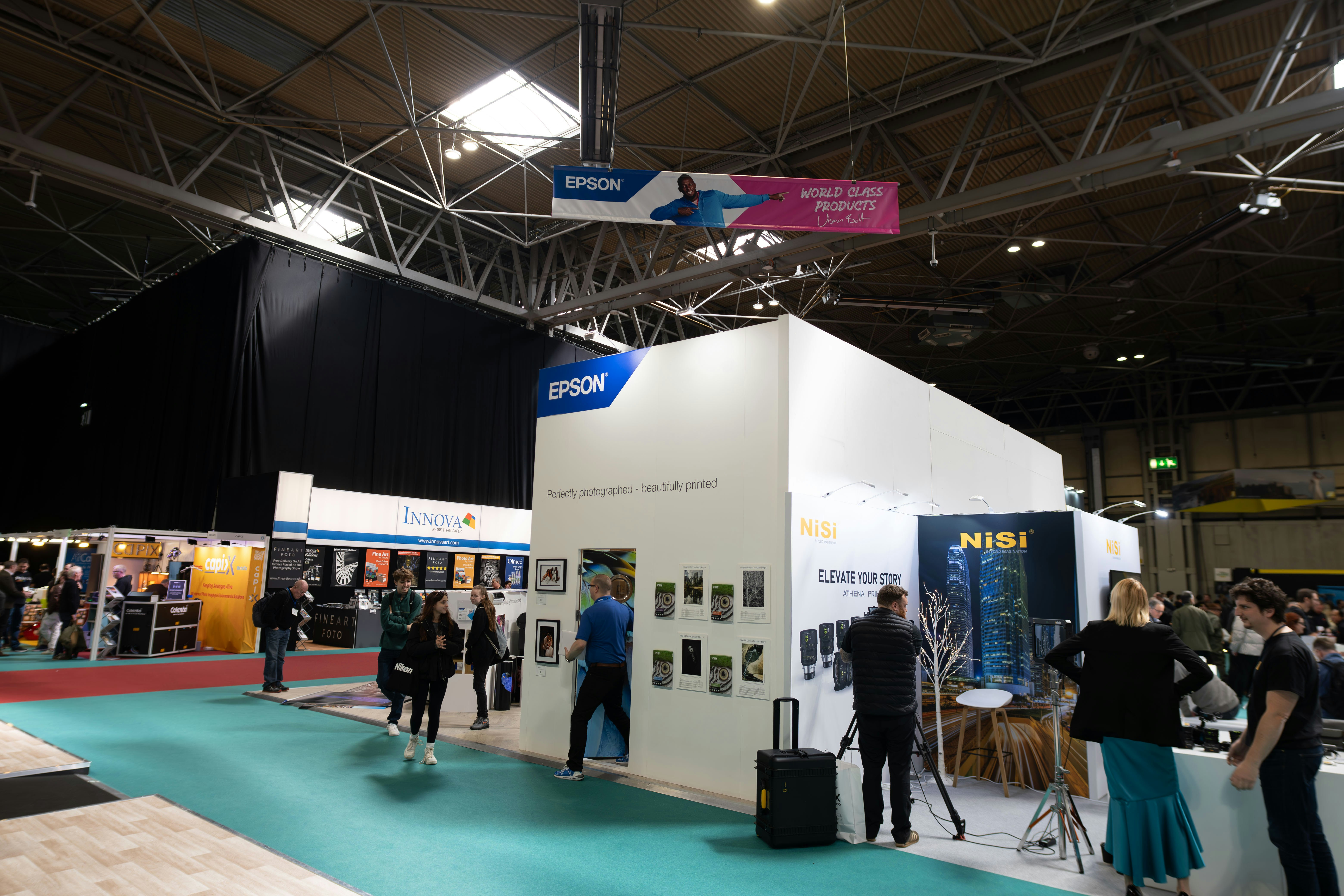
A trade show or expo booth has to do several jobs at once that a printed piece never does.
It has to read from across a crowded hall. Attendees are scanning, moving, and half-distracted. If the space doesn't register from a distance, nothing else about it matters.
It has to work as a space someone moves through. There's an outside and an inside, and they have different jobs. The exterior is an invitation — it earns the walk over. The interior is the experience — it justifies the walk and gives someone a reason to stay.
It has to survive event lighting, which is rarely flattering and never what you'd choose.
And it has to photograph well, because attendees are going to post from inside it. That's not a bonus. For a personal brand, the photos taken in that space travel considerably further than the foot traffic through it.
An expo booth has two distinct design jobs. The exterior has to read from across a crowded hall and earn the walk over. The interior has to justify the walk and give someone a reason to stay. Designing them as one continuous surface usually means one of them underperforms.
This is what made the project genuinely interesting. It wasn't one brand in a space. It was all of Stormy's brands, together, in one environment.
That's a harder problem than it sounds. Give each brand its own treatment and the space fragments into a trade show inside a trade show — visitors can't tell what they're looking at or how the pieces relate. Flatten everything into one look and you erase what makes each brand distinct, which defeats the point of showing them together.
The approach that works is a shared visual system with distinct zones. Something consistent carries across the entire space — a color logic, a typographic voice, a repeating graphic language — so it reads as one environment from the door. Within that, each brand gets enough of its own identity to be recognizable up close.
Someone standing outside sees one coherent thing. Someone walking through discovers the parts.
When one space has to represent multiple brands, use a shared visual system with distinct zones. Consistent color logic and typography make it read as one environment from a distance, while each brand keeps enough individual identity to be recognizable up close.
There's an additional layer when the brand is a person.
An audience with a direct relationship to an individual can tell immediately when a space feels corporate rather than personal. It has to feel like her — not like a booth with her logo applied to it. That's harder to specify and easier to get wrong than any technical requirement in the project.
Practically, it means the energy of the space has to match the energy of the person. For this project that meant vibrant and colorful rather than restrained and premium, because restrained and premium would have been a beautifully executed mismatch.
Whether it's a national expo or a county chamber event, the same principles hold:
Design the approach, not just the booth. What does someone see from thirty feet away? That's the first design problem, and it's usually the last one people think about.
Give people a reason to stop moving. A table with a banner behind it is a checkpoint. A space someone steps into is an experience.
Assume photos. Somebody will take pictures. Make sure there's something worth being photographed in front of, ideally with your brand legible in frame.
Plan for bad lighting. Design that depends on perfect conditions will not get perfect conditions.
What is experiential marketing?
Marketing built around a physical space or event someone participates in rather than a message they receive passively. Trade show booths, pop-up activations, and branded environments are common forms. The goal is an experience people remember and share.
How do you design a trade show booth that stands out?
Start with how it reads from a distance, since that determines whether anyone approaches. Then design the interior as a separate job — the reason to stay once they've arrived. Booths that treat the whole thing as one surface tend to under-deliver on one half.
How do you display multiple brands in one space?
Use a shared visual system — consistent color logic, typography, and graphic language — so the space reads as one environment, with distinct zones giving each brand enough identity to be recognizable up close.
Does booth design actually matter at events?
Substantially. Attendees walk past far more booths than they visit, and that decision is made from a distance in seconds. Design determines who approaches, and the photographs taken inside frequently reach a larger audience than the event itself.
What's different about designing for a personal brand?
The audience has a direct relationship with the individual, so anything that feels generic or corporate registers as inauthentic quickly. The space has to match the person's actual energy rather than a category convention.
How far in advance should event graphics be designed?
Earlier than most people plan for. Large-format printing, fabrication, and shipping all have lead times, and rushed production limits your material and finish options. Building in buffer for a reprint is worth it.
Have an event or activation coming up? Schedule a free consultation at jpetrous.com | contact@jpetrous.com | 586-563-6634.



.jpg)
The businesses winning in Michigan aren't chasing trends. Jonathan Petrous shares a practical 2027 marketing playbook built specifically for the Michigan small business market.
Read More
Great local businesses in Marysville, Chesterfield, and Macomb Township are invisible online — and it's fixable. Jonathan Petrous explains the three most common causes and exactly what to do about them.
Read More
Tight marketing budget in Port Huron or the surrounding area? Jonathan Petrous shares the highest-leverage moves local businesses can make right now — most of them free or nearly free.
Read More


Jpetrous Creative Services proudly supports businesses across:
Macomb County • St. Clair County • Metro Detroit • Southeast Michigan
Including communities like:
New Baltimore • Chesterfield • Sterling Heights • Clinton Township
St. Clair • Marysville • Port Huron • Rochester • Auburn Hills • Detroit





























Before you go
Call or send a message. Tell me what you're working on and I'll tell you honestly whether I'm the right fit.