
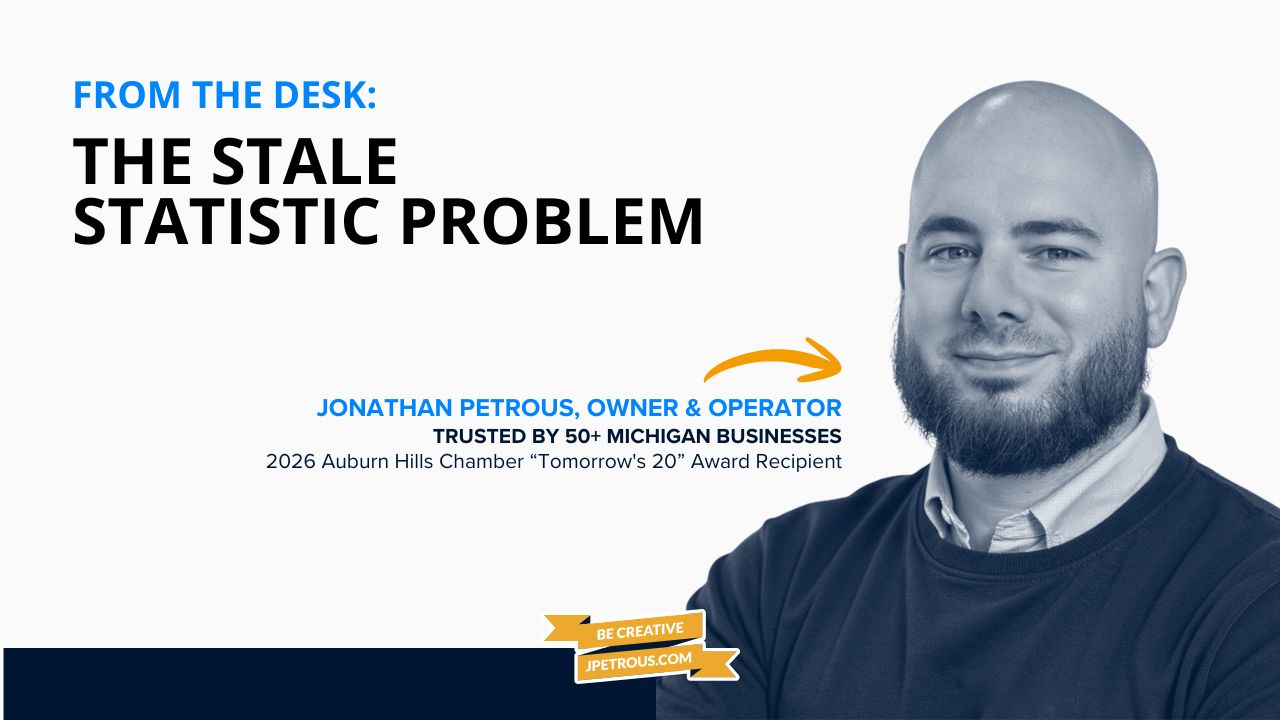

A few weeks back I sat down and reread my own service guide — the one I hand people, the one I've had live for over a year — like I'd never seen it before.
That's a bad way to spend an afternoon. Also a necessary one.
I want to be clear about something first, because it matters to me: I didn't make anything up. The numbers came from somewhere real — research I'd actually read at some point, not something I invented to sound good. The problem wasn't fabrication. It was that I could no longer point back to where any of it came from, and a number without a traceable source doesn't get to stay, no matter how confident I feel about it.
The "20–40% more inquiries" line is the clearest example. It came from industry research and benchmark data I'd read a while back, not a client result. I couldn't fabricate it if I tried; the problem is I also can't retrace it now. Content online gets rewritten, republished, and reworded constantly, and whatever report or article I originally pulled that range from has been superseded by newer versions I can't match back to what I actually read. I trust that it came from somewhere real. I can't currently prove it. So it's coming out until I can.
Before I looked closely, I would've told you my materials were fine — I hadn't reread that guide in a long time, and everything in it felt true because, in a sense, it was. The audit just held it to a stricter bar: not "is this true," but "can I currently point to where this came from." When that got flagged, I didn't argue about it — I pulled the guide off the site that day. It's still down. I'd rather hand people nothing for a few weeks than hand them a number I can't stand behind, and the version going back up will have real math behind every claim, not a range I half-remember reading somewhere. One number held up clean through the whole process, and it's staying: the in-house-versus-retainer math, which runs $95K–$160K a year for a full-time hire depending on the role.
There was a second flagged line I didn't want to just quietly delete: a "50–70% savings versus in-house" claim. Instead of dropping it, I actually did the homework this time — real 2026 salary data for what a full-time designer or marketing hire costs once you load in taxes, benefits, and overhead, and real 2026 pricing for what a traditional agency retainer runs, compared against what I actually charge. Turns out the honest number is bigger than the one I'd been guessing at — closer to 85% savings against hiring in-house, and somewhere in the 60–90% range against a traditional full-service agency, depending on which tier you're comparing. I'd undersold myself with a made-up range. The real, sourced number is stronger than the vague one ever was.
It's worth saying, since a post going up this month talks about it directly: I used AI tools to help run that check — not to write claims, but to catch what I'd stopped seeing in my own work after reading it too many times. That's the line for me.
This isn't just a me problem, either. I look at other local businesses' marketing more than I probably should, and the same thing shows up constantly — "we increase leads by X%," no source, no context. Sometimes it's fabricated. More often, I'd bet it's exactly what happened to me: a real result that lost its context somewhere between the first draft and the fifth.
If you want a takeaway you can use this week: open whatever you hand new clients — your site, your one-pager, your deck — and check whether every number still has its story attached. Not "is this technically true," but "could I tell you, right now, exactly where this came from and who it happened to." If you can't, either find the source or attach the name back to it.
My rule going forward: every number gets a source, or it comes out. If you want to see what that looks like without any numbers at all — just a client, a rebuilt budget, and a lot of transparency — that's Scotty's story. → Full story
Next month I'm writing about the opposite problem — the times I've told a client they need less than they asked for, and what that's actually cost me.
— Jon
Jonathan Petrous
Owner & Operator, Jpetrous Creative Services
jpetrous.com | jonathan@jpetrous.com | 586-563-6634




You built the email, it looked great in preview, and then someone sent you a screenshot where everything collapsed. Email is the most technically hostile environment in digital design. Here's what actually survives it.
Read More
Pro bono work can build your portfolio and your standing in the community. It can also eat your billable hours and set a precedent you'll have to undo. An honest ledger from someone who just finished a big one.
Read More
They handled my wedding flowers and, years later, a custom corsage for the Daddy-Daughter Dance. A Main Street florist that's also a full gift shop.
Read More


Before you go
Call or send a message. Tell me what you're working on and I'll tell you honestly whether I'm the right fit.